
PSA Levels by Age Chart: What Elevated Results Mean
If you searched "normal PSA levels by age," you probably have a number in front of you and a knot in your stomach. Here is the honest version: there is no single PSA that is "normal" for every man, but there are well-established age ranges, and a number above them is a reason to ask questions, not to panic. An elevated PSA is the start of a conversation, not a diagnosis.
Seek urgent care for inability to urinate, fever with pelvic pain, severe bone pain, or major bleeding.
Board-certified urologist and robotic surgeon · Founder and Chief Medical Officer
Last reviewed June 9, 2026
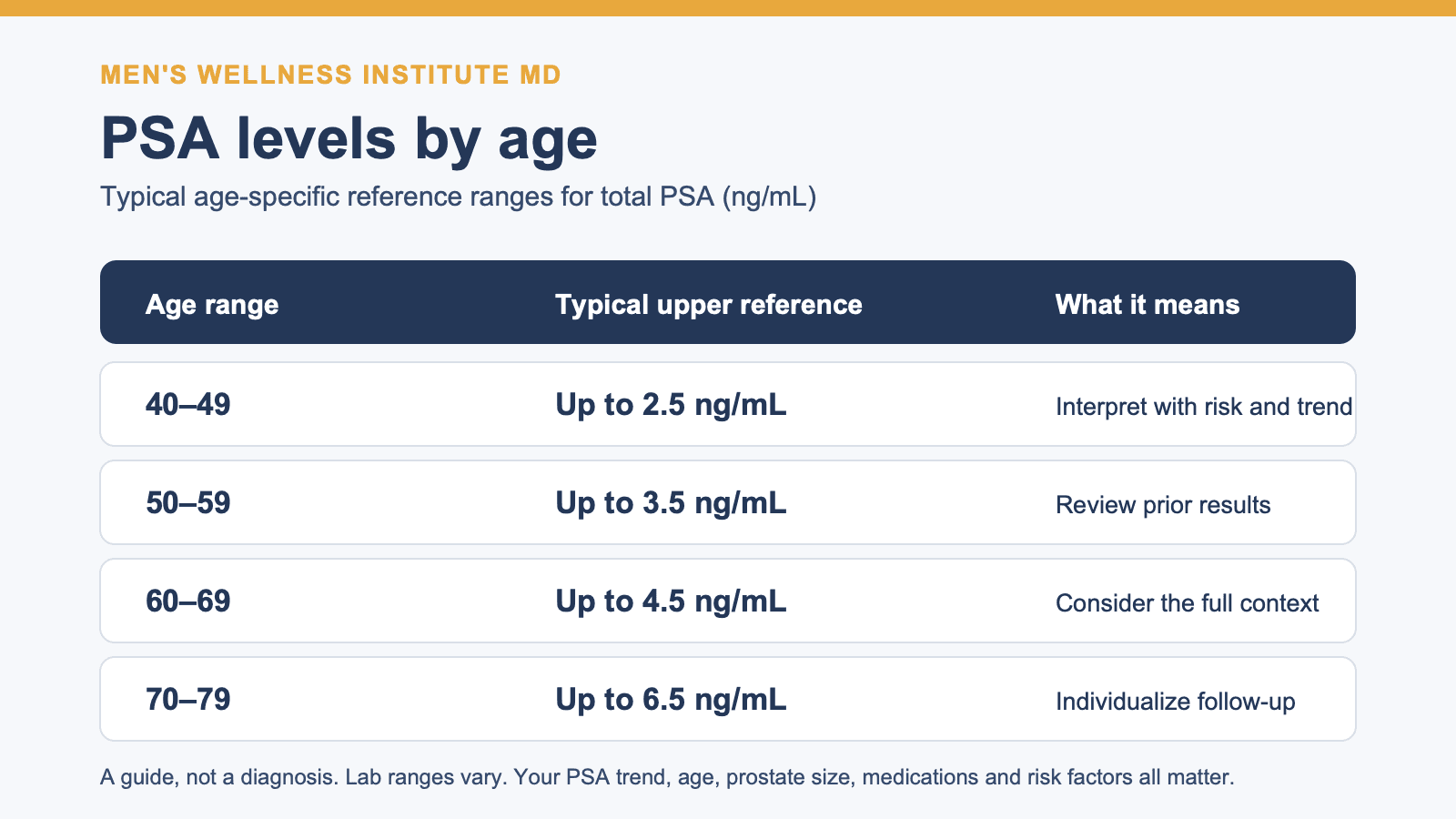
- PSA naturally rises with age, so "normal" is age-specific: roughly ≤2.5 ng/mL in your 40s, ≤3.5 in your 50s, ≤4.5 in your 60s, and ≤6.5 in your 70s.
- These ranges vary by lab and source. A result just outside the range is common and usually not cancer.
- Most elevated PSAs are caused by benign things: an enlarged prostate (BPH), inflammation or infection (prostatitis), a recent ride on a bike, or sex in the last day or two.
- Only about 1 in 4 men who get a biopsy for an elevated PSA turn out to have prostate cancer (NCI).
- The trend over time and the rate of change often matter more than a single number.
- A repeat test, sometimes an MRI, and a urologist's interpretation come before any biopsy — that is the whole point of doing this carefully.
What "normal" PSA actually means
Prostate-specific antigen (PSA) is a protein made by the prostate — a walnut-sized gland that sits below the bladder and wraps around the urethra. Both healthy and cancerous prostate tissue make PSA, which is why the test is useful but never a yes-or-no answer on its own.
Doctors tend to avoid the word "normal" and instead talk about whether a level is "elevated" for your age. That is because PSA rises naturally as the prostate grows over the decades. A 2.4 ng/mL might be unremarkable for a 68-year-old and worth a closer look in a 45-year-old. The number only means something in context: your age, your prostate size, your prior results, and what you were doing in the days before the blood draw.
Normal PSA levels by age: the chart
Below are the age-specific reference ranges most urology practices and labs use as a starting point. They come from large studies of men without prostate cancer and are echoed by sources like Cleveland Clinic and the age-related PSA reference literature. Read the upper number as "above this, your clinician will usually take a closer look" — not as a cancer threshold.
| Age range | Typical / expected PSA | Upper end of "expected" | What an above-range result usually triggers |
|---|---|---|---|
| 40–49 | 0 – 2.5 (often <1.0) | 2.5 ng/mL | Repeat test; consider a baseline trend, family history |
| 50–59 | 0 – 3.5 | 3.5 ng/mL | Repeat test; DRE; review risk factors |
| 60–69 | 0 – 4.5 | 4.5 ng/mL | Repeat test; often an MRI before any biopsy |
| 70–79 | 0 – 6.5 | 6.5 ng/mL | Interpreted alongside overall health and life expectancy |
Ranges vary by laboratory, assay, and source (e.g., AUA / UrologyHealth.org, the NCI PSA fact sheet, Johns Hopkins, and Mayo Clinic all frame "elevated" slightly differently). Some practices use a single threshold of 2.5 ng/mL under age 60 and 4.0 ng/mL at 60 and older; the decade-by-decade ranges above are a more granular, widely used alternative. These figures are a guide, not a diagnosis. A number outside the range is a reason to talk with a clinician — it is not, by itself, a verdict. A normal-range PSA also does not rule prostate cancer out entirely.
An elevated PSA needs interpretation, not panic
This is the part the chart cannot show. An elevated PSA is common, and most of the time it is not cancer. According to the National Cancer Institute, only about 1 in 4 men who go on to have a biopsy because of an elevated PSA are actually found to have prostate cancer — and roughly 6–7% of men get a false-positive PSA result on any given screening round.
So before anyone says the word "biopsy," a good workup asks simpler questions first. Was the prostate inflamed or infected? Is it just enlarged with age? Did something temporarily push the number up? Is this a one-time reading or a trend? Those answers change everything, and they are exactly what a urologist is trained to sort out.
What can raise PSA that isn't cancer
Plenty of everyday and benign things move PSA, sometimes substantially. This is why a single high number is rarely acted on immediately, and why prep before the test matters.
- An enlarged prostate (benign prostatic hyperplasia, or BPH) — the single most common reason PSA drifts up with age.
- Prostatitis or a urinary tract infection — inflammation can spike PSA for weeks, sometimes to 20 ng/mL or higher, before it settles once treated.
- Ejaculation or sexual activity in the previous 24–48 hours.
- Vigorous cycling or anything that puts sustained pressure on the perineum shortly before the draw.
- A recent catheter, cystoscopy, or prostate procedure or biopsy (PSA can stay up for a month or more afterward).
- Testosterone therapy, which can modestly raise PSA.
- Note the reverse: drugs for BPH or hair loss (finasteride, dutasteride) can roughly halve your PSA, so your clinician adjusts how they read it.
What counts as a dangerously high PSA by age?
There is no fixed "danger number," and PSA has no ceiling — levels can run into the hundreds or higher. But clinicians use rough bands to gauge urgency. The table below pairs the commonly cited elevation bands with what they tend to prompt. Crucially, the same number reads differently at 52 than at 75: a 6.0 in a 75-year-old with a large prostate is far less alarming than a 6.0 in a man in his early 50s.
| PSA band | Often described as | Rough cancer likelihood / what it tends to prompt |
|---|---|---|
| Below your age range | Within expected limits | Routine interval testing; watch the trend over time |
| 4 – 10 | Minimally elevated | About a 1-in-4 chance on biopsy; repeat test, often MRI before biopsy |
| 11 – 20 | Moderately elevated | Likelihood rises above 50%; closer workup is typical |
| 21 – 50 | High elevation | Stronger suspicion; prompt urology evaluation |
| Above 50 | Markedly elevated | Usually a strong indicator of cancer; rarely explained by infection alone |
Bands adapted from NCI and major cancer-center guidance (e.g., MD Anderson, Cleveland Clinic). They describe the size of an elevation, not a diagnosis. A fast-rising level or an abnormal exam can matter as much as the absolute number, and age and overall health always shape what a value means.
What is a worrisome PSA number?
A genuinely worrisome PSA is less about crossing one magic line and more about the full picture. In practice, three things tend to move a number from "recheck it" to "let's look closely": a value clearly above your age-specific range, a level that is climbing faster than expected over successive tests, and a firm or irregular prostate on exam. Any of these — and especially two together — is what prompts a urologist to act.
A single value in the 4–10 range is common and frequently benign, so on its own it is a reason to repeat the test and consider an MRI, not to assume the worst. A PSA above 10, a rapidly rising trend, or a markedly elevated number in a younger man is more concerning and warrants prompt evaluation. The honest takeaway: "worrisome" is a pattern a clinician recognizes, not a number you can fully judge alone.
The trend, velocity, and density matter more than a single number
One of the most useful things about PSA is watching it over time. A stable 3.0 year after year is reassuring. A PSA that climbs from 1.2 to 2.0 to 3.1 over three years — even while technically "in range" — can be more telling than a one-time 4.5.
To sharpen a borderline result, urologists look at refinements of the raw number rather than the raw number alone. You do not need to memorize these; the point is that your single value is rarely the whole story, and a good workup uses them to avoid unnecessary biopsies.
- PSA velocity — how fast the level is rising. A sustained rise of more than about 0.75 ng/mL per year can prompt a closer look even when the absolute value is still "in range."
- PSA density — the level relative to prostate size on imaging. A density above roughly 0.15 ng/mL per gram leans toward investigating further rather than attributing the rise to simple enlargement.
- Free vs. total PSA — the percentage of PSA circulating unbound. A lower free fraction (often cited as under ~15%) leans slightly more toward cancer; a higher fraction (over ~25%) leans toward benign causes.
- Newer blood and urine tests, plus prostate MRI, can refine the picture further before anyone considers a biopsy.
What happens after an elevated PSA
A careful, stepwise path is the standard of care — and it is designed to avoid unnecessary procedures. Most men move through some version of the following, guided by their age, risk, and exam.
- Repeat the PSA in about 6–8 weeks to confirm it is real and not a temporary blip (per NCI guidance).
- Review history and do a digital rectal exam (DRE) to feel for any firmness or asymmetry.
- Consider a prostate MRI, which can non-invasively flag suspicious areas — and often spares men a biopsy.
- Use the trend, MRI findings, and sometimes adjunct blood/urine tests to decide whether a targeted biopsy is warranted.
- Reserve biopsy for when the combined picture — not one number — points there.
What your result means, and the next step
It helps to map a result onto a plan. The bands below are a general orientation — your clinician personalizes them to your age, history, and exam — but they show why most paths start with a recheck, not a procedure.
- Comfortably within your age range: reassuring. Continue your usual screening interval and keep prior results so the trend stays visible.
- Borderline — near the top of your age range: often a recheck in a few weeks, sometimes a free-PSA test or closer follow-up to read the trend.
- Elevated for your age: a systematic evaluation — repeat testing, possibly an MRI — to separate benign causes from anything that needs a biopsy.
- Rising trend, even if "in range": worth closer monitoring; velocity and density help decide whether to investigate now.
- Abnormal exam with any PSA: evaluated on its own merits, because some cancers do not raise PSA much.
When to start the PSA conversation
Screening is a shared decision, not an automatic yearly ritual. The U.S. Preventive Services Task Force recommends men aged 55–69 weigh the benefits and harms with their clinician and decide individually, and does not recommend routine PSA screening at 70 and older. Major urology and cancer guidelines suggest starting the conversation earlier — around age 40–45 — for higher-risk men.
- Black men, who face a higher risk of prostate cancer and of more aggressive disease.
- Men with a father or brother who had prostate cancer.
- Men with a known BRCA1 or BRCA2 mutation or a strong family cancer history.
- Men already having urinary symptoms — frequency, weak stream, getting up at night — where a prostate evaluation makes sense regardless.
How Men's Wellness Institute reads your PSA
At Men's Wellness Institute MD, a PSA result is never handled as a lone number. Our founder, Dr. Domenico Savatta, is a board-certified urologist and robotic surgeon, so an elevated or rising PSA is interpreted the way it should be — against your age range, your prostate exam, your prior results, and the benign explanations first. Where it helps, that can include repeat testing, imaging, and a clear explanation of what each step is and is not telling you.
If you have a PSA you do not understand, urinary symptoms, or a family history that has you wondering when to start screening, that is exactly the kind of conversation to bring in. You can request information through this page; insurance and any costs are confirmed before scheduling, and the goal is a calm, accurate read — not a rush to a procedure.
Move from education into the right clinical conversation.
Frequently asked questions
What is a good PSA range by age?
As a general guide, expected PSA is roughly at or below 2.5 ng/mL in your 40s, 3.5 in your 50s, 4.5 in your 60s, and 6.5 in your 70s, with many men sitting well under those numbers. These ranges vary by lab and source, so the figure on your report is best interpreted by a clinician alongside your age, prior results, and exam — it is a conversation starter, not a pass/fail line.
What is a high PSA level for a 70-year-old?
For men in their 70s, levels up to about 6.5 ng/mL are often within the expected range because the prostate is typically larger by this age. A PSA above that, or one that has jumped noticeably from prior tests, usually warrants a closer look. In older men, results are also weighed against overall health and life expectancy, since not every finding needs aggressive follow-up. A urologist can tell you what your specific number means.
What is a dangerous PSA level by age?
There is no single "dangerous" cutoff and no upper limit to PSA. Clinicians use rough bands: 4–10 ng/mL is minimally elevated (about a 1-in-4 chance of cancer on biopsy), 11–20 is moderately elevated, and above 10 the probability rises past 50% (NCI; Cleveland Clinic). Levels above 50 are usually a strong indicator of cancer. Very high numbers raise suspicion, but a fast-rising level or an abnormal exam can matter as much as the absolute value, and a 6.0 reads differently at 75 than at 52. Any markedly elevated PSA should be evaluated promptly — but elevation alone is not a diagnosis.
What is a worrisome PSA number?
A worrisome PSA is usually a pattern, not a single line: a value clearly above your age-specific range, a level rising faster than expected across tests, or a firm or irregular prostate on exam — especially two of those together. A one-off reading of 4–10 is common and often benign, so it typically prompts a repeat test and sometimes an MRI rather than alarm. A PSA above 10, a rapid rise, or a markedly elevated number in a younger man is more concerning and warrants prompt urology evaluation.
What is the fastest way to lower your PSA?
If a benign cause is driving the number, treating it — for example, an antibiotic course for prostatitis, or simply avoiding ejaculation and vigorous cycling for 48 hours before a retest — can bring PSA down on a recheck. Some research links a plant-forward diet, regular exercise, and adequate vitamin D to modestly lower PSA, but there is no guaranteed quick fix, and you should never try to "lower" a PSA to avoid evaluation. The safer move is to have an elevated PSA interpreted, not masked.
Does an elevated PSA always mean cancer?
No. Most elevated PSAs are not cancer. According to the National Cancer Institute, only about 1 in 4 men biopsied for an elevated PSA are found to have prostate cancer, and roughly 6–7% of men get a false-positive on any given screening round. Benign prostatic enlargement (BPH), prostatitis, infection, and recent activity are far more common explanations. An elevated number means "let's interpret this," not "you have cancer."
What can temporarily raise PSA before a test?
Several everyday things can push PSA up for a short time: ejaculation or sexual activity in the prior 24–48 hours, vigorous cycling, a urinary tract infection or prostate inflammation, and recent procedures like a catheter, cystoscopy, or biopsy (which can elevate PSA for weeks). To get a cleaner reading, many clinicians advise avoiding ejaculation and hard cycling for about two days beforehand. By contrast, BPH and hair-loss drugs (finasteride, dutasteride) can lower PSA by roughly half.
Is a PSA of 4.5 normal?
It depends on your age. A 4.5 ng/mL is around the upper end of the expected range for a man in his 60s, but it would be above the typical range for someone in his 40s or 50s. Because the value sits near a common decision point, a clinician will usually repeat the test and consider your trend, prostate exam, and risk factors before deciding whether any further step — such as an MRI — is needed. The same number can be reassuring or worth investigating depending on the person.
How often should I get a PSA test?
There is no one-size answer. For men who choose screening, every one to two years is common, with closer follow-up if a level is borderline or rising. The U.S. Preventive Services Task Force frames PSA screening for ages 55–69 as an individual decision made with your clinician and does not recommend routine screening at 70 and older. Higher-risk men — Black men, or those with a strong family history or a BRCA mutation — may start the conversation around age 40–45.
- National Cancer Institute — Prostate-Specific Antigen (PSA) Test
- Urology Care Foundation (AUA) — What is Prostate Cancer / PSA
- Mayo Clinic — PSA test: Overview
- Cleveland Clinic — PSA Test (normal PSA by age)
- Johns Hopkins Medicine — Prostate Cancer: Age-Specific Screening Guidelines
- U.S. Preventive Services Task Force — Prostate Cancer: Screening
- Liu X, et al. Reference Ranges of Age-Related PSA in Men without Cancer (PMC)
This page is educational and does not provide medical advice, diagnosis, or treatment. A clinician must evaluate your individual situation.