
Foamy Urine in Men: What the Toilet Bowl Can—and Cannot—Tell You
A toilet-bowl picture can show what people mean by foamy urine, but it cannot show whether protein is present or tell you which organ is responsible. A fast stream, concentrated urine, or cleaning residue may create temporary bubbles. Foam that repeatedly returns—especially with swelling, blood in the urine, pain, fever, a weak stream, or trouble emptying—deserves testing and the right clinical route rather than a visual guess.
Seek urgent care for inability to urinate, severe lower-abdominal pain, fever with flank or back pain, heavy blood or clots, severe worsening pain, fainting, confusion, or shortness of breath.
Board-certified urologist and robotic surgeon · Founder and Chief Medical Officer
Last reviewed July 25, 2026
- An occasional layer of bubbles is common and does not diagnose kidney disease.
- Persistent foam can occur when protein, including albumin, is present in urine, but appearance alone cannot confirm proteinuria.
- A urinalysis and urine albumin-to-creatinine ratio are more useful than comparing the toilet bowl with an online photo.
- Primary care can often start the evaluation; kidney-filter findings may lead toward nephrology, while blood, stones, infection, obstruction, prostate, or bladder symptoms may lead toward urology.
- Inability to urinate, severe lower-abdominal pain, fever with flank pain, heavy blood or clots, or rapidly worsening symptoms should not wait for an online appointment.
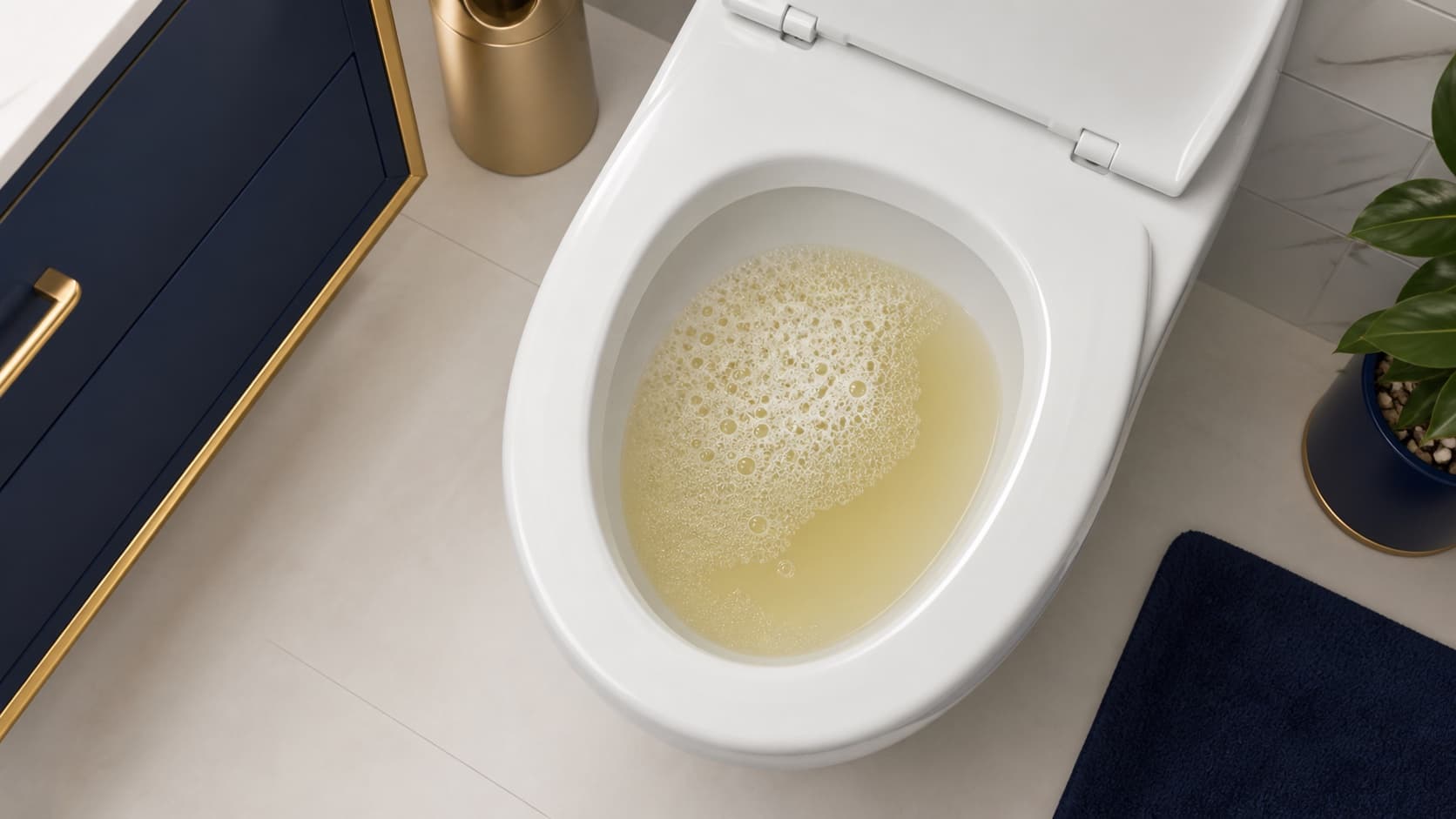

Why MWI is showing a picture—but not using it as a diagnosis
Men often want to know whether what they saw is normal before they bring up a bathroom symptom. A clear visual can reduce embarrassment and make the conversation easier. It can also mislead if it is presented as a diagnostic comparison. Lighting, toilet shape, water level, cleaning products, stream force, and urine concentration can all change the surface pattern.
The illustration on this page is therefore a conversation aid, not a normal-versus-disease test. You do not need to upload a toilet photo to this public website. If the pattern keeps returning, write down when it happens, how long it has been happening, and what other urinary or whole-body symptoms are present. A properly collected urine sample is more useful than a photograph.
Occasional bubbles versus a pattern worth checking
A full bladder can create a faster, stronger stream that traps air when urine hits the water. Concentrated urine and residue from toilet-cleaning products can also make bubbles more noticeable. That context is more reassuring when it happens once, clears, and does not come with other symptoms.
The safer reason to schedule an evaluation is repetition: foam that is new, appears regularly under similar conditions, seems to be increasing, or occurs with swelling, unusual fatigue, blood in the urine, burning, fever, flank pain, weak stream, or incomplete emptying. Persistence does not prove kidney disease; it means testing is more informative than continued visual monitoring.
| Pattern or symptom | What it may help the clinician separate | Reasonable next step |
|---|---|---|
| One-time bubbles after a forceful stream or in a recently cleaned toilet | Air, concentration, and cleaning-product effects can change the surface appearance. | Notice whether it repeats in a different clean toilet and mention it if the pattern persists. |
| Foam that repeatedly returns | Protein or albumin is one possibility, but appearance cannot confirm it. | Arrange a clinician visit for urinalysis and the appropriate urine-protein measurement. |
| Foam with swelling around the feet, ankles, hands, or eyes | Fluid retention can occur with kidney and other medical conditions. | Seek timely medical guidance and ask whether kidney-function and urine-albumin testing are needed. |
| Foam with pink, red, brown, or cola-colored urine | Blood can originate from the kidneys or urinary tract and needs evaluation. | Contact a clinician promptly; heavy blood, clots, severe pain, fever, or retention needs urgent care. |
| Foam with weak stream, urgency, retention, recurrent infection, or stone-type pain | A prostate, bladder, stone, infection, or blockage question may be present alongside—or instead of—a kidney-filter issue. | A urology-led evaluation may fit, with urine tests or imaging chosen from the full symptom pattern. |
This table helps organize a conversation. It cannot identify the cause of foam or replace examination and laboratory testing.
Proteinuria and albuminuria: the kidney-filter question
Proteinuria means that protein is present in urine. Albumin is a protein normally kept in the bloodstream by healthy kidney filters. Albuminuria—too much albumin in urine—can be a sign of kidney disease, even before a person feels sick. Diabetes, high blood pressure, heart disease, and a family history of kidney failure can make urine-albumin testing especially important.
A positive result still needs context. Exercise, dehydration, infection, and other temporary factors can affect urine protein, and a clinician may repeat testing before deciding what a result means. The National Institute of Diabetes and Digestive and Kidney Diseases considers a urine albumin-to-creatinine ratio above 30 mg/g higher than normal, but one number should not be interpreted without kidney function, medical history, medicines, blood pressure, and the reason the test was ordered.
The first tests are more useful than another picture
A clinician may start with a urinalysis, which can check for protein, blood, glucose, signs of infection, and other findings. A urine albumin-to-creatinine ratio, often shortened to UACR, estimates albumin relative to creatinine and helps account for how concentrated the sample is. Blood creatinine and estimated glomerular filtration rate may be used to look at kidney function.
The rest of the workup depends on the pattern. Burning or fever may prompt infection testing. Blood in urine, stone-type pain, recurrent infections, weak stream, retention, or an abnormal urinary-tract finding may lead to urology tests or imaging. Diabetes or blood-pressure risk may require broader primary-care or kidney follow-up. There is no single foamy-urine panel that fits every man.
Kidney specialist or urologist: which route fits the evidence?
Primary care is often a practical starting point when foam is the only new, non-urgent observation. The first urine and blood tests can show whether the concern looks more like a kidney-filter problem, a urinary-tract problem, or a temporary finding that needs repeat testing.
| Route | Findings that may fit | What to bring |
|---|---|---|
| Primary care | New persistent foam without an emergency; need for blood pressure, diabetes risk, urinalysis, UACR, kidney-function tests, and initial referral direction. | Symptom timeline, medication and supplement list, blood-pressure or diabetes history, and prior urine or kidney results. |
| Nephrology | Repeated or significant albumin/protein, reduced or changing kidney function, swelling, difficult blood-pressure control, or another kidney-disease pattern. | Urine-protein results, creatinine/eGFR trend, blood-pressure readings, diabetes history, medication list, and family kidney history. |
| Urology | Visible or microscopic blood, stones, recurrent urinary infections, weak stream, retention, prostate or bladder symptoms, pain, obstruction, or structural urinary-tract questions. | Urinalysis and culture results, imaging, prior urology procedures, medication list, and a concise urinary-symptom timeline. |
Some men need both specialties. Kidneys filter the blood; urology also evaluates the drainage system, including the ureters, bladder, prostate, and urethra.
Where a urology-led MWI conversation may help
Foam alone does not automatically make this a urology problem. Urology becomes more relevant when the same man also has blood in urine, kidney-stone symptoms, recurrent infection, a weak or interrupted stream, urgency, frequent urination, incomplete emptying, retention, known prostate enlargement, bladder symptoms, or a prior urinary procedure.
The useful question is not simply, ‘Is the urine foamy?’ It is, ‘What other findings travel with it, and which test changes the next decision?’ That approach helps avoid two mistakes: dismissing a kidney signal because there is no pain, or assuming every bathroom change belongs to the kidneys when the urinary tract may also need evaluation.
Warning signs that should not wait
Seek urgent medical care if you are suddenly unable to urinate, have severe lower-abdominal pain with a full-bladder feeling, develop fever with flank or back pain, pass heavy visible blood or clots, have severe or rapidly worsening pain, or feel faint, confused, short of breath, or acutely unwell.
For a non-urgent but persistent pattern, do not stop prescription medicines or try to treat a visual symptom on your own. Record the timeline and related symptoms, then use a clinician visit to decide whether urine testing, kidney-function testing, infection testing, imaging, or specialist referral is appropriate.
Move from education into the right clinical conversation.
Frequently asked questions
Should I be worried if my urine is foamy?
An occasional episode can happen from a fast stream, concentrated urine, or toilet-cleaning residue. Foam that repeatedly returns, increases, or appears with swelling, blood, pain, fever, weak stream, or trouble emptying deserves a clinician visit and urine testing.
Can drinking more water reduce foamy urine?
Hydration may make concentrated urine less noticeable, but it is not a diagnostic test or a substitute for evaluation. Persistent foam or foam with other symptoms should still be discussed with a clinician.
Does foamy urine mean diabetes?
Not by itself. Diabetes can damage kidney filters and lead to albumin in urine, but a toilet-bowl appearance cannot diagnose diabetes or kidney disease. Blood sugar, urine, kidney-function, and clinical history are what answer that question.
What tests are commonly used for persistent foamy urine?
A clinician may start with urinalysis and a urine albumin-to-creatinine ratio, then consider blood creatinine/eGFR, blood pressure, diabetes testing, urine culture, imaging, or referral based on symptoms and results.
Should a man see a nephrologist or a urologist for foamy urine?
Primary care can often start. Nephrology may fit repeated albumin or protein, reduced kidney function, swelling, or a kidney-disease pattern. Urology may fit blood in urine, stones, infection, weak stream, retention, bladder symptoms, prostate symptoms, or structural urinary-tract concerns.
Can a photo show whether there is protein in urine?
No. A photo can document appearance but cannot confirm protein or identify the cause. Urinalysis and a urine albumin-to-creatinine ratio are more useful.
When is foamy urine urgent?
Urgent evaluation is appropriate for inability to urinate, severe lower-abdominal pain, fever with flank or back pain, heavy visible blood or clots, severe or worsening pain, fainting, confusion, shortness of breath, or rapidly worsening illness.
This page is educational and does not provide medical advice, diagnosis, or treatment. A clinician must evaluate your individual situation.